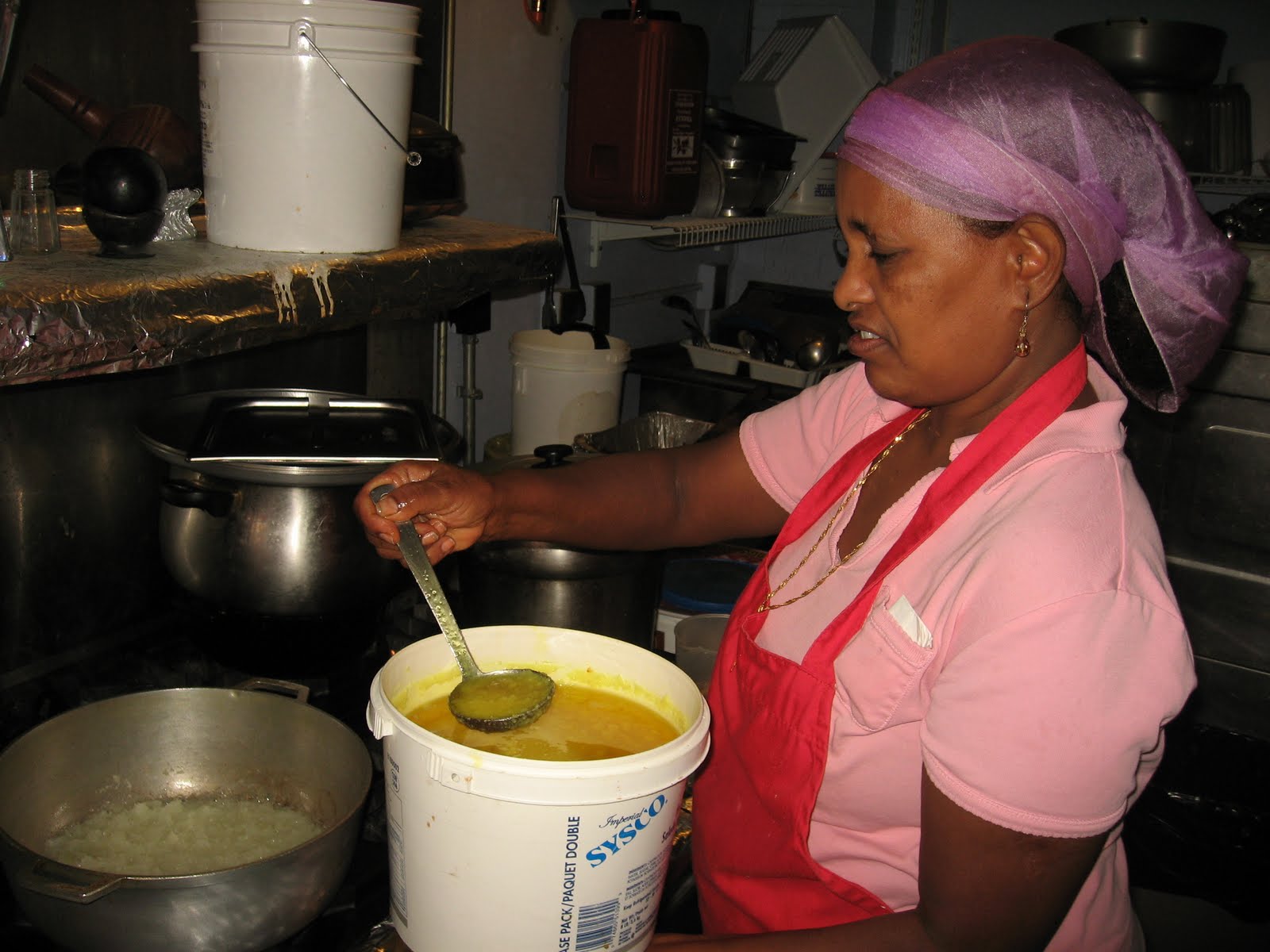
I’ve always wanted to learn how to cook injera, a spongy crepe served at Asmara, an Eritrean restaurant in Portland, with gorgeous piles of creamy orange lentils, cabbage and potatoes, kale, and spicy chicken. I’m thrilled that chef-owner Asmeret Teklu has agreed to teach me. Three ingredients are mixed together for ingera batter: The first is teff flour, made out of the protein-rich teff grain that grows in Ethiopia and Eritrea. The second is water. And the third is soured teff starter, which is responsible for the crepe’s wonderful tang and the air bubbles that make the surface look like pumice.
When Asmeret arrived here thirteen years ago, a friend gave her some starter. Ever since then, Asmeret’s been using the reminder of her batter as the starter for the next batch. “But where did your friend get her starter?” I asked. She laughs at my guessing, “There is no beginning.” I think maybe in addition to evolutionism and creationism we should be teaching our children injera-ism. There simply is no beginning. Mankind has been warring forever, and it has been giving the tricks of survival forever, too. When Asmeret left Eritrea, she passed dead bodies on the side of the road. Then she walked in a group of twenty strangers at night in the jungle for 7 days, hiding under big leaves and in forest caves from Ethiopian soldiers. She carried peanuts and dried fruit in her backpack. Now she teaches me how to make spicy chicken.
Saute about two cups minced yellow onion with a little water in a covered shallow pot. After a while, add 1½ tablespoons of ghee. (Ghee is butter that’s been simmered, its cloudy protein removed). Asmeret reaches into complete darkness under the countertop, and pulls out mixing spoon piled high with red powder. “Berbere,” she nearly whispers, not sure if it translates. “Berbere!?” I cry, not believing my circumstance. My former boss, chef Elizabeth Defranco at the Harraseeket Inn, had once muttered berbere like it was something the Indiana Jones of Cooking might go on mission to recover in order to save mankind from imploding once and for all. I dip my pointer finger in some of the red powder and suck it.
Berbere, I detect, “is really spicy chili powder, salt, and... and...” Asmeret laughs. “You can’t separate.” I can’t taste the scant black pepper, fenugreek, allspice, cloves, coriander, rue or ajwain, but any combination of them could be in there. Swipes of Asmeret’s wooden spoon leave silver trails through the dark red scene in the bottom of the pot. She peels the skins off 8 drumsticks and soaks them in water with half of a lemon. Then she loosens the thick paste with a cup of tomato sauce and 3 blended whole tomatoes and lets the sauce cook again covered. Finally, she adds the drumsticks to the sauce, 1½ Tbsp minced garlic, stirs, covers, and lets the chicken cook until the meat shrinks revealing the anklebones.
Suddenly I channel, quite to my surprise, the southern drawl of my grandmother from Oklahoma: “Well all be.” I think the saying was polite for “I’ll be damned.” I like her turn of phrase much better. “Well all be.” It leaves acknowledgement of the damned for the news, and salutes the wellness, goodness, and giving that constantly, forever and ever, and ever and ever, has been filling in between. Thank you, Asmeret.
Asmara
51 Oak Street
Portland, ME
207-253-5122
copyright Lindsay Sterling 2010